

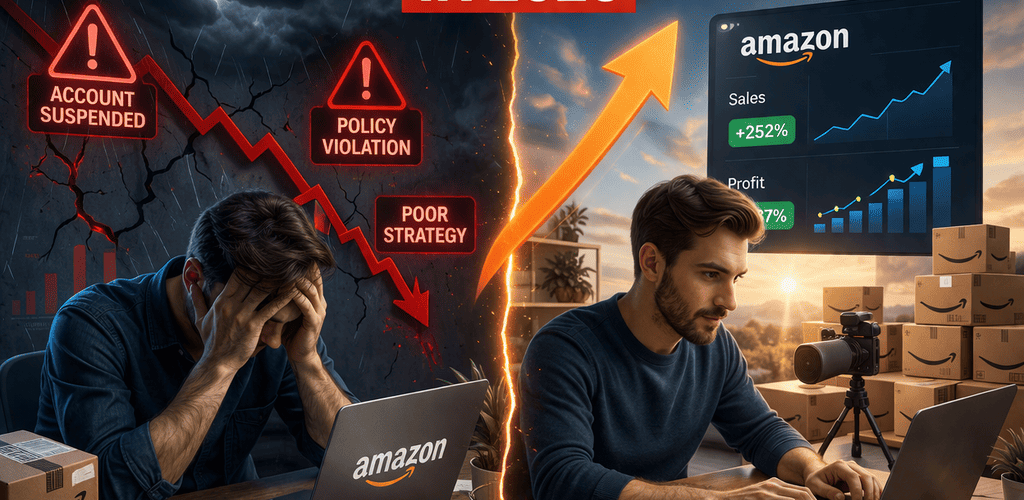
The idea of building a successful Amazon FBA business still attracts thousands of new sellers every month. On the surface, it looks simple: find a product, list it, run ads, and start making money. But the reality in 2026 is very different. Amazon is no longer an easy-entry marketplace where basic strategies work. It has matured into a highly competitive ecosystem where only well-prepared, strategic sellers survive.
The statistic that “90% of Amazon sellers fail” is not an exaggeration it reflects a growing trend. Most sellers don’t fail because the opportunity is gone; they fail because they approach Amazon with outdated methods, unrealistic expectations, and a lack of understanding of how the platform actually works today.
To succeed in 2026, you need to understand why sellers fail and how to avoid making the same mistakes.
The Shift in Amazon’s Ecosystem
Amazon has evolved significantly over the past few years. Rising fulfillment fees, stricter compliance regulations, and increasingly competitive advertising costs have reshaped the way sellers operate. At the same time, customer expectations have grown. Buyers now expect premium-quality products, strong branding, fast delivery, and a seamless shopping experience.
This shift has created a clear divide between two types of sellers: those who treat Amazon as a serious business and those who treat it as a quick money-making opportunity. The former group adapts, invests, and grows. The latter struggles and eventually exits.
Understanding this shift is the first step toward avoiding failure.
The Root Cause: Poor Product Selection
One of the biggest reasons sellers fail is choosing the wrong product. Many beginners rely on surface-level research methods, such as chasing trending products or copying what appears to be selling well. While these approaches may have worked years ago, they are no longer effective in today’s competitive environment.
In 2026, simply finding a product with demand is not enough. The real question is whether you can compete in that market. If the niche is saturated with established brands that have strong reviews, high-quality listings, and optimized advertising campaigns, entering without differentiation is a losing strategy.
Successful sellers focus on solving real problems. They analyze customer reviews to identify pain points, improve existing products, and create something that offers clear value. Instead of asking, “Is this product selling?” they ask, “How can I make this product better?”
This shift in thinking is what separates profitable sellers from those who struggle to gain traction.
The Branding Gap That Kills Growth
Another critical mistake sellers make is ignoring branding. Many still treat Amazon as a transactional marketplace where the cheapest product wins. However, Amazon has increasingly become a brand-driven platform where trust and perception play a major role in purchasing decisions.
When customers browse listings, they are not just comparing prices—they are evaluating credibility. A product with poor images, generic packaging, and weak messaging immediately signals low quality, even if the product itself is decent.
In contrast, strong brands create confidence. They invest in professional visuals, consistent messaging, and a clear identity. This doesn’t just improve conversion rates; it also builds long-term customer loyalty.
Sellers who fail to build a brand often find themselves stuck in price wars, constantly lowering margins just to stay competitive. Over time, this becomes unsustainable and leads to burnout or exit.
Why Most Listings Don’t Convert
A common misconception among new sellers is that ranking on Amazon is purely about keywords. While keywords are important for visibility, they are not enough to drive sales. The real driver of success is conversion rate.
In 2026, Amazon’s algorithm heavily favors listings that convert well. If your product gets traffic but fails to convert, your ranking will drop, and your advertising costs will increase. This creates a negative cycle that is difficult to escape.
Poor listing optimization is a major contributor to this problem. Many sellers write generic bullet points, use low-quality images, and fail to communicate the product’s benefits effectively. Instead of focusing on what the customer gains, they focus on features that don’t resonate.
High-performing listings, on the other hand, are designed to sell. They use compelling headlines, clear benefit-driven messaging, and visually engaging images that demonstrate the product in real-life scenarios. They address objections, build trust, and guide the customer toward making a purchase.
Without this level of optimization, even a good product will struggle.
The Advertising Trap
Amazon PPC has become more competitive and expensive than ever. Many sellers enter the platform without a clear advertising strategy, assuming that running ads alone will generate sales. As a result, they burn through their budget without achieving profitability.
The problem is not advertising itself—it’s how it is managed. Inexperienced sellers often rely solely on automatic campaigns or fail to analyze performance data. They continue spending on keywords that don’t convert and scale campaigns prematurely.
In 2026, successful advertising requires a structured and data-driven approach. Sellers must continuously analyze metrics such as ACOS, TACOS, and conversion rates to identify what is working and what isn’t. Advertising is no longer just about visibility; it is about efficiency.
Those who fail to adapt to this reality often find themselves spending more than they earn, leading to unsustainable losses.
Inventory Mismanagement and Its Consequences
Inventory management is another area where many sellers struggle. Running out of stock can be devastating, as it leads to a loss of ranking and momentum. On the other hand, overstocking results in high storage fees, which eat into profits.
In 2026, Amazon’s inventory system is less forgiving. Sellers are expected to maintain a balance between supply and demand. This requires careful planning, accurate forecasting, and constant monitoring of sales trends.
Sellers who ignore inventory management often face a cycle of instability. They either miss out on sales due to stockouts or lose money due to excess inventory. Both scenarios can significantly impact long-term growth.
Compliance: The Silent Business Killer
One of the most overlooked aspects of selling on Amazon is compliance. As regulations become stricter, especially in regions like Europe, sellers are required to provide proper documentation, certifications, and compliance information.
Failure to meet these requirements can result in listing removals, account suspensions, or even permanent bans. Many sellers underestimate the importance of compliance until it is too late.
In 2026, compliance is not optional it is a fundamental part of running an Amazon business. Sellers must stay informed about regulations, prepare necessary documentation, and ensure their products meet all requirements.
Ignoring this aspect can quickly turn a profitable business into a costly mistake.
The Review and Trust Factor
Customer reviews continue to play a crucial role in Amazon’s ecosystem. They influence both conversion rates and search rankings. However, many sellers fail to actively manage their reviews or improve their products based on customer feedback.
A product with poor reviews struggles to gain traction, regardless of how much is spent on advertising. On the other hand, products with strong ratings and positive feedback build trust and generate organic sales.
Successful sellers understand that reviews are not just feedback they are a growth tool. They use customer insights to improve their products, address issues, and enhance the overall customer experience.
The Dangerous Mindset of Quick Success
Perhaps the most significant reason sellers fail is their mindset. Many enter Amazon expecting quick profits and passive income. When results don’t come immediately, they lose motivation and abandon their efforts.
The reality is that Amazon is a long-term business. Building a successful brand takes time, investment, and consistent effort. Sellers who approach it with patience and a willingness to learn are far more likely to succeed.
Those who chase shortcuts often end up frustrated and disappointed.
How to Stay in the Top 10%
Avoiding failure in 2026 is not about finding secret hacks or hidden strategies. It is about executing the fundamentals at a high level. This means choosing the right product, building a strong brand, optimizing for conversion, managing advertising effectively, maintaining inventory balance, and staying compliant with regulations.
Most importantly, it requires a shift in mindset. Instead of looking for quick wins, successful sellers focus on long-term growth. They invest in their business, learn from their mistakes, and continuously improve.
Amazon is still one of the most powerful platforms for building an eCommerce business. The opportunity is very much alive—but only for those who are willing to adapt.
Final Thoughts
The reason 90% of Amazon sellers fail in 2026 is not because the platform is oversaturated or impossible to succeed in. It is because most sellers are not prepared for what Amazon has become.
It is no longer a shortcut to easy money. It is a competitive, data-driven marketplace that rewards strategy, consistency, and execution.
If you approach Amazon with the right mindset and focus on building a real business rather than chasing quick profits, you can position yourself in the top 10% of sellers who not only survive but thrive.