

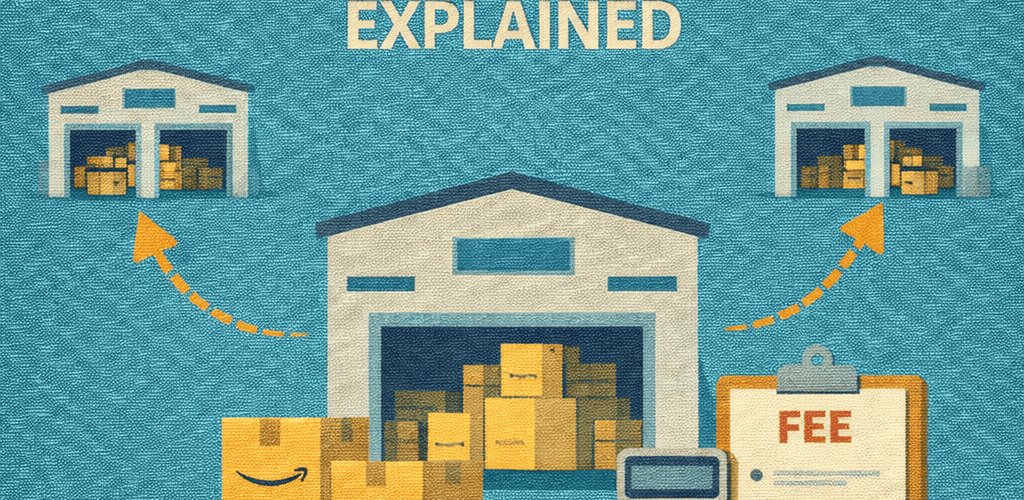
Amazon FBA has long been promoted as a hands‑off fulfillment solution where sellers simply send inventory and let Amazon manage the rest. However, as Amazon’s logistics network has expanded and delivery expectations have accelerated, the fee structure behind FBA has become more complex. One of the most misunderstood and impactful changes is the Amazon FBA Inbound Placement Fee.
Many sellers first notice this fee when creating a shipment and suddenly seeing higher estimated costs, even though nothing seems different about their inventory. This article explains the inbound placement fee in full detail what it is, why it exists, how it is calculated, and how sellers can manage or reduce its impact on profitability.
What Is the Amazon FBA Inbound Placement Fee?
The Amazon FBA inbound placement fee is a charge applied when a seller chooses to send inventory to fewer fulfillment centers than Amazon’s system recommends. Amazon operates a vast, regionally distributed fulfillment network designed to place inventory close to customers. When inventory arrives at only one or two locations, Amazon must internally move units across its network to ensure fast delivery coverage. The inbound placement fee exists to offset the cost of that internal redistribution.
In practical terms, Amazon is offering sellers a choice. Sellers can either ship inventory to multiple fulfillment centers upfront, following Amazon’s optimized placement plan, or they can ship to fewer locations for convenience and allow Amazon to do the redistribution later for a fee. The inbound placement fee represents the cost of choosing convenience over network efficiency.
Why Amazon Introduced the Inbound Placement Fee
Amazon introduced the inbound placement fee as part of a broader effort to optimize its logistics network and control fulfillment costs. Over the past few years, Amazon has invested heavily in regional fulfillment centers, same‑day delivery hubs, and faster shipping promises. To make these systems work efficiently, inventory must be evenly distributed across regions.
Previously, Amazon absorbed most of the cost of moving inventory between warehouses. As seller volume increased and logistics expenses rose, Amazon shifted part of that cost to sellers who do not follow distributed placement instructions. The fee is not a penalty; it is an incentive mechanism designed to encourage sellers to participate in inventory optimization rather than relying on Amazon to fix placement after the fact.
When the Inbound Placement Fee Applies
The inbound placement fee applies when a seller overrides Amazon’s recommended shipment distribution. During shipment creation, Amazon calculates where inventory should be sent based on demand forecasts, regional sales velocity, and fulfillment capacity. If a seller chooses to send all units to a single fulfillment center or selects a minimal‑split option, Amazon applies a per‑unit inbound placement fee.
If the seller follows Amazon’s assigned fulfillment center destinations and sends inventory to all required locations, no inbound placement fee is charged. The fee is therefore optional in the sense that it is tied directly to the seller’s placement decision.
Shipment Placement Options Explained
When creating an FBA shipment, sellers are typically presented with at least two placement approaches. The first is Amazon‑optimized placement, where inventory is split across multiple fulfillment centers. This option usually involves more complex logistics and higher outbound shipping coordination, but it does not incur an inbound placement fee.
The second option is minimal shipment splits, which allows sellers to send inventory to fewer destinations. This option simplifies freight planning, labeling, and carrier coordination, but it triggers the inbound placement fee. Many sellers mistakenly choose this option without comparing the total landed cost, assuming fewer shipments always mean lower expenses.
How the Inbound Placement Fee Is Calculated
The inbound placement fee is calculated on a per‑unit basis and varies depending on product size tier and shipment configuration. Standard‑size items generally incur a lower fee, while oversized products can carry significantly higher costs due to increased handling and transportation requirements.
Amazon displays the exact inbound placement fee during shipment creation before final confirmation. This transparency allows sellers to compare scenarios in real time, but many sellers overlook the breakdown and only notice the impact later when reviewing profit margins.
Real‑World Cost Example
Consider a seller sending 1,000 standard‑size units into FBA. If the seller follows Amazon’s optimized placement plan, the shipment may be split across four fulfillment centers. While the outbound shipping cost might be higher due to multiple destinations, there is no inbound placement fee.
If the seller chooses minimal shipment splits and sends all 1,000 units to a single fulfillment center, the outbound shipping cost may be lower. However, Amazon may apply an inbound placement fee of approximately $0.30 to $0.50 per unit. In this scenario, the seller could save $80–$100 on shipping but pay $300–$500 in placement fees, resulting in a significantly higher total cost.
Impact on FBA Profitability
The inbound placement fee directly affects a product’s landed cost, which in turn impacts break‑even pricing, advertising efficiency, and overall profit margins. For low‑priced or low‑margin products, even a small per‑unit fee can eliminate profitability entirely.
Sellers running aggressive PPC campaigns may find that their previously profitable ACOS targets are no longer sustainable once inbound placement fees are added to the cost structure. This makes it essential to account for inbound placement fees when calculating true product margins.
Sellers Most Affected by the Fee
Sellers who operate with thin margins, sell low‑priced products, or rely on frequent small restocks are typically the most affected by inbound placement fees. High‑volume sellers and private‑label brands with larger shipments may absorb the cost more easily, but the fee still compounds over time and can significantly reduce annual profits.
How to Reduce or Avoid Inbound Placement Fees
The most effective way to avoid inbound placement fees is to follow Amazon’s optimized placement recommendations whenever possible. Although this requires more upfront shipping coordination, it almost always results in a lower total cost. Planning larger shipments less frequently can also reduce per‑unit logistics costs and make multi‑destination shipping more economical.
Sellers should also take advantage of Amazon partnered carriers, which often provide competitive rates even for multi‑warehouse shipments. Optimizing packaging to reduce product size tier can further lower both fulfillment and inbound placement costs.
Common Seller Mistakes
One of the most common mistakes sellers make is choosing minimal shipment splits without reviewing the total cost impact. Another frequent error is failing to update profitability calculations and PPC targets after inbound placement fees are introduced. Over time, these small miscalculations can lead to sustained losses.
Is Paying the Inbound Placement Fee Ever Worth It?
In some cases, paying the inbound placement fee can make sense. Sellers with complex international freight operations, limited warehouse access, or urgent restocking needs may value simplicity and speed over cost efficiency. However, for most sellers, optimized placement is the better long‑term strategy.
Final Thoughts
The Amazon FBA inbound placement fee is not simply another hidden charge; it is a signal from Amazon that inventory efficiency matters. Sellers who understand how and why the fee applies can make smarter shipment decisions, protect profit margins, and maintain scalable operations. By evaluating total landed cost instead of focusing solely on shipping convenience, sellers can stay competitive in an increasingly fee‑sensitive FBA environment.
Leave A Comment