

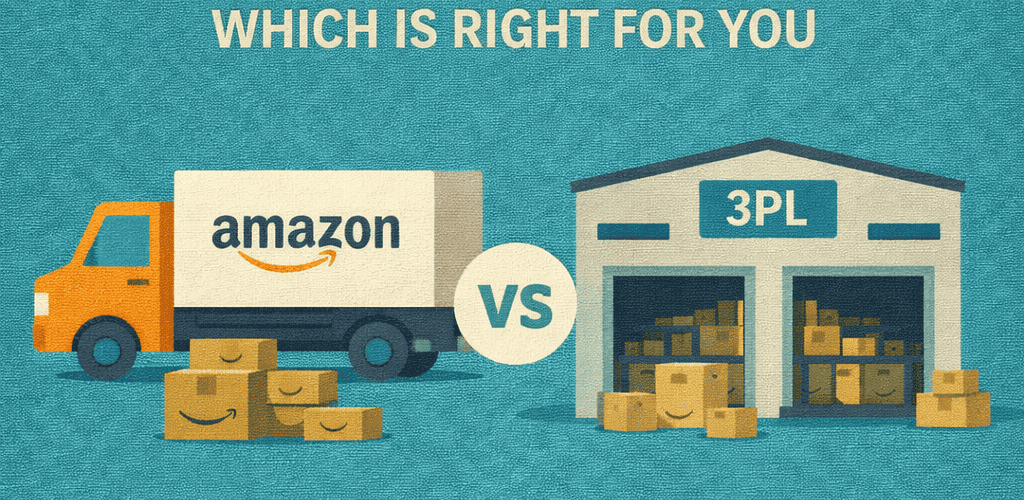
Fulfillment is the backbone of every successful eCommerce business. No matter how good your product is or how effective your marketing strategy may be, poor fulfillment decisions can destroy margins, damage customer trust, and limit scalability. For sellers operating on Amazon or expanding beyond it, one of the most common and important decisions is choosing between Amazon FBA (Fulfillment by Amazon) and 3PL (Third-Party Logistics) fulfillment.
Both fulfillment models aim to solve the same problem storing inventory and delivering orders to customers but they operate in fundamentally different ways. Understanding these differences in depth is essential for making a strategic decision that aligns with your business goals, cost structure, and long-term growth plans.
This guide provides a comprehensive, detailed comparison of Amazon FBA vs 3PL fulfillment, explained clearly and entirely in narrative form.
Understanding Amazon FBA Fulfillment
Amazon FBA is a fulfillment service where sellers send their inventory to Amazon’s fulfillment centers, and Amazon handles the rest of the process. Once products are stored in Amazon warehouses, Amazon takes responsibility for picking, packing, shipping, customer service, and returns. From the seller’s perspective, Amazon FBA offers an almost fully automated logistics solution.
One of the primary reasons sellers choose Amazon FBA is convenience. Managing warehousing, shipping carriers, customer inquiries, and returns can be operationally demanding. Amazon FBA eliminates much of that workload, allowing sellers to focus on sourcing, product development, and advertising. This hands-off fulfillment approach is particularly attractive to new sellers or small teams that lack logistics infrastructure.
Another defining feature of Amazon FBA is Prime eligibility. Products fulfilled by Amazon automatically qualify for Amazon Prime, which gives customers access to fast and often free shipping. Prime eligibility plays a significant role in purchasing decisions on Amazon, as Prime customers tend to prefer listings that offer fast delivery. This often results in higher conversion rates compared to merchant-fulfilled listings.
The Advantages of Amazon FBA in Practice
Amazon FBA excels in providing speed and reliability. Amazon’s logistics network is one of the most advanced in the world, offering one-day or two-day delivery in many regions. Customers trust Amazon’s shipping promises, and this trust directly benefits sellers using FBA.
Another advantage is scalability within the Amazon ecosystem. As order volume increases, sellers do not need to worry about hiring warehouse staff, negotiating shipping contracts, or expanding storage space. Amazon automatically scales fulfillment capacity to match demand, even during peak seasons such as Prime Day or Q4.
Customer service is another area where Amazon FBA simplifies operations. Amazon handles most customer inquiries related to shipping, delivery, and returns. This reduces the operational burden on sellers and ensures a standardized customer experience.
The Limitations and Risks of Amazon FBA
Despite its convenience, Amazon FBA comes with notable limitations that sellers must carefully consider. One of the most significant drawbacks is cost. Amazon FBA fees include fulfillment fees, storage fees, long-term or aged inventory surcharges, and additional charges for removals or disposals. While these fees may seem manageable at first, they can quickly erode margins, especially for products that are large, heavy, or slow-moving.
Inventory control is another challenge with Amazon FBA. Amazon imposes inventory limits and restock caps, particularly during high-demand periods. These restrictions can prevent sellers from sending sufficient inventory to meet demand, leading to lost sales and ranking declines.
Brand control is also limited. Amazon controls packaging, unboxing experience, and most customer communication. Sellers cannot include branded inserts freely or customize the delivery experience. This makes it difficult to build a strong, recognizable brand identity when relying solely on FBA.
Perhaps the biggest risk associated with Amazon FBA is platform dependency. Sellers operating exclusively on FBA are heavily dependent on Amazon’s policies and systems. Account suspensions, listing suppressions, policy changes, or sudden fee increases can disrupt the entire business overnight. This lack of control is a major concern for sellers thinking long-term.
What Is 3PL Fulfillment and How It Works
3PL fulfillment refers to outsourcing logistics operations to an independent third-party company that specializes in warehousing and shipping. Unlike Amazon FBA, 3PL providers are not tied to a single marketplace. They can fulfill orders for Amazon (via FBM), Shopify, WooCommerce, Walmart, TikTok Shop, and other sales channels simultaneously.
In a 3PL model, sellers send inventory to the provider’s warehouse. When an order is placed on any connected platform, the order information is transmitted to the 3PL system, which then picks, packs, and ships the product to the customer. Tracking details are automatically sent back to the sales channel.
This model is particularly popular among brands that sell through multiple channels or prioritize direct-to-consumer growth.
The Key Strengths of 3PL Fulfillment
One of the most significant advantages of 3PL fulfillment is flexibility. Sellers retain far more control over inventory, packaging, and shipping decisions compared to Amazon FBA. Custom packaging, branded inserts, and personalized unboxing experiences are all possible with 3PL providers, making it easier to build brand loyalty.
Multi-channel fulfillment is another major strength. A single 3PL warehouse can support multiple sales platforms, allowing sellers to manage inventory centrally instead of splitting stock across different fulfillment systems. This simplifies forecasting and reduces the risk of overstocking or stockouts.
From a cost perspective, 3PL fulfillment can be more economical for certain product types. Large, bulky, or slow-moving products often incur high storage fees under Amazon FBA. In contrast, many 3PL providers offer more flexible storage pricing, making them better suited for such inventory.
Inventory visibility and control are also superior in most 3PL systems. Sellers typically have access to detailed dashboards that show real-time inventory levels, order status, and warehouse performance. This transparency helps with demand planning and operational decision-making.
The Challenges of Using a 3PL
Despite its advantages, 3PL fulfillment is not without challenges. One of the most noticeable limitations is the absence of Prime eligibility. Products fulfilled through a 3PL do not automatically qualify for Prime, which can reduce conversion rates on Amazon unless the seller qualifies for programs like Seller Fulfilled Prime.
Operational responsibility is also higher with 3PL fulfillment. Sellers often need to manage customer service, returns, and carrier-related issues themselves or through additional support systems. This increases complexity and may require a dedicated operations team.
Service quality can vary significantly between 3PL providers. Not all 3PLs offer the same level of accuracy, speed, or reliability. Choosing the wrong partner can lead to delayed shipments, incorrect orders, and negative customer feedback. Due diligence and performance monitoring are critical when working with a 3PL.
Cost Comparison Between Amazon FBA and 3PL
Amazon FBA offers predictable pricing but with layered fees that can be difficult to optimize. Sellers benefit most when products are small, lightweight, and fast-moving. In these cases, the convenience and Prime eligibility often outweigh the costs.
3PL pricing structures are more customizable but less standardized. Costs typically include storage, pick-and-pack fees, and shipping charges. While this may seem complex, it allows sellers to negotiate terms that align with their specific product dimensions and order volume. For many brands, especially those scaling beyond Amazon, 3PL fulfillment becomes more cost-efficient over time.
Shipping Speed and Customer Experience
Amazon FBA sets the industry standard for delivery speed. Fast, reliable shipping is one of Amazon’s strongest competitive advantages, and FBA sellers benefit directly from it. Customers are more likely to trust delivery estimates provided by Amazon, which reduces purchase hesitation.
3PL shipping speed depends largely on warehouse location and carrier partnerships. While it may not always match Amazon’s speed, a strategically chosen 3PL with multiple warehouse locations can still provide competitive delivery times. Additionally, 3PL fulfillment enables a more branded and personalized customer experience, which is especially important for direct-to-consumer brands.
Returns Management and Customer Support
Amazon FBA simplifies returns by handling them automatically according to Amazon’s policies. This convenience benefits customers but often leaves sellers with limited control over how returned inventory is inspected or restocked. Damaged returns and refund abuse are common complaints among FBA sellers.
With 3PL fulfillment, sellers have greater control over return policies and inspection processes. This allows for better quality control and brand protection, particularly for premium or fragile products.
Scalability and Long-Term Business Growth
Amazon FBA is excellent for scaling within Amazon but offers limited flexibility beyond it. Sellers who rely exclusively on FBA often find it difficult to expand into new channels without restructuring their fulfillment strategy.
3PL fulfillment supports long-term scalability across multiple platforms and international markets. It allows businesses to grow independently of any single marketplace, reducing risk and increasing resilience.
Hybrid Fulfillment as a Strategic Solution
Many experienced sellers adopt a hybrid fulfillment strategy that combines Amazon FBA and 3PL fulfillment. In this model, top-selling products are fulfilled through Amazon FBA to benefit from Prime eligibility, while slower-moving, oversized, or DTC-focused inventory is handled by a 3PL. This approach balances convenience with control and reduces dependency on Amazon alone.
Conclusion
Choosing between Amazon FBA and 3PL fulfillment is not about finding a one-size-fits-all solution, but about aligning your fulfillment strategy with your business goals, product type, and long-term vision. Amazon FBA offers unmatched convenience, fast Prime shipping, and higher conversion potential on Amazon, making it an excellent option for sellers who want a hands-off approach and primarily sell within the Amazon ecosystem. However, rising fees, inventory limits, and limited brand control can become major constraints as a business grows.
On the other hand, 3PL fulfillment provides greater flexibility, stronger branding opportunities, and the ability to scale across multiple sales channels with more control over inventory and costs. While it requires more operational involvement and careful partner selection, 3PL is often better suited for brands focused on long-term independence and multi-channel expansion.
For many sellers, the most effective solution is a hybrid approach that combines Amazon FBA for fast-moving, Prime-eligible products with 3PL fulfillment for direct-to-consumer, oversized, or slower-moving inventory. By understanding the strengths and limitations of each model, you can build a fulfillment strategy that supports profitability, reduces risk, and positions your business for sustainable growth.
Leave A Comment