

Selling on Amazon requires more than just listing products and running ads. Amazon operates under strict policies designed to protect customers, maintain marketplace trust, and ensure fair competition among sellers. Because of this, Amazon constantly monitors seller activity, product listings, customer feedback, and brand complaints.
During this monitoring process, sellers may receive notifications from Amazon regarding policy compliance. Two of the most common notifications sellers encounter are policy warnings and policy violations. While these terms may seem similar, they represent two very different levels of severity and consequences.
Many sellers panic when they see these notifications, while others make the mistake of ignoring them completely. Both reactions can be harmful to a seller’s business. Understanding the difference between a warning and a violation can help sellers take the correct action at the right time and protect their Amazon accounts from serious enforcement actions such as listing removal or account suspension.
In this article, we will explore the meaning of Amazon policy warnings and policy violations, how they differ from each other, how they impact seller accounts, and what sellers should do when they receive these notifications.
What Is an Amazon Policy Warning?
An Amazon policy warning is essentially a notification from Amazon informing a seller that there may be an issue related to their listing, account activity, or compliance with Amazon’s rules. However, at the stage of a warning, Amazon has not yet taken strict enforcement action against the seller.
You can think of a policy warning as Amazon’s way of telling sellers that something appears problematic and should be reviewed or corrected. The goal of these warnings is often preventative. Amazon prefers to give sellers an opportunity to fix potential issues before they escalate into confirmed policy violations.
In most cases, a policy warning does not remove the product listing, suspend the account, or directly damage the account health rating. Instead, it serves as an early alert that something about the listing or activity may be risky, misleading, or non-compliant with Amazon’s policies.
These warnings usually appear in the seller’s Performance Notifications section inside Seller Central, and sometimes Amazon also sends an email explaining the concern.
For example, Amazon might detect that a product listing contains claims that could potentially mislead customers. In such a case, Amazon may send a warning stating that the listing content should be reviewed and corrected. The listing may remain active, but the seller is expected to fix the issue promptly.
Another common scenario involves intellectual property concerns. If Amazon’s system detects that a listing contains brand names, trademarks, or copyrighted terms that may not belong to the seller, it may issue a warning. Amazon is essentially informing the seller that their listing might infringe on someone else’s intellectual property, even if a formal complaint has not yet been filed.
Keyword misuse can also trigger warnings. Sellers sometimes add irrelevant or misleading keywords to gain more visibility in search results. When Amazon detects keyword abuse or manipulation, it may send a warning instructing the seller to correct the listing content.
Although a warning does not usually lead to immediate penalties, it should never be ignored. Amazon expects sellers to respond proactively and correct the problem before it escalates.
What Is an Amazon Policy Violation?
A policy violation is much more serious than a policy warning. A violation occurs when Amazon determines that a seller has clearly broken one of its marketplace policies.
In this situation, Amazon does not simply notify the seller of a potential issue. Instead, Amazon confirms that a rule has been violated and typically takes enforcement action immediately.
These enforcement actions can include removing the listing, suppressing the ASIN, requesting documentation, limiting selling privileges, or in severe cases suspending the seller account.
When a violation occurs, it is usually recorded in the Account Health Dashboard, which tracks the overall compliance status of the seller account. Repeated violations can lower a seller’s account health rating and increase the risk of account suspension.
One of the most common violations sellers encounter is an intellectual property complaint. If a brand owner reports that a seller is infringing on their trademark or selling counterfeit products, Amazon will usually remove the listing immediately and record a policy violation.
Another common violation involves restricted products. Amazon maintains strict rules regarding certain product categories such as medical devices, supplements, electronics, safety equipment, and hazardous materials. If a seller lists a restricted product without proper approval or certification, Amazon may remove the listing and issue a violation.
Product authenticity complaints are also serious violations. If a brand owner or customer claims that a product sold by a seller may not be genuine, Amazon may request invoices or supplier documentation. If the seller fails to provide sufficient proof of authenticity, the violation may remain on the account and further action may follow.
Product safety violations are among the most severe. If Amazon determines that a product poses a risk to customers or does not meet regulatory standards, the platform may permanently remove the product listing and potentially restrict the seller from listing similar products in the future.
Because violations represent confirmed policy breaches, sellers often need to take corrective action and sometimes submit an appeal to resolve the issue.
The Core Difference Between Policy Warnings and Violations
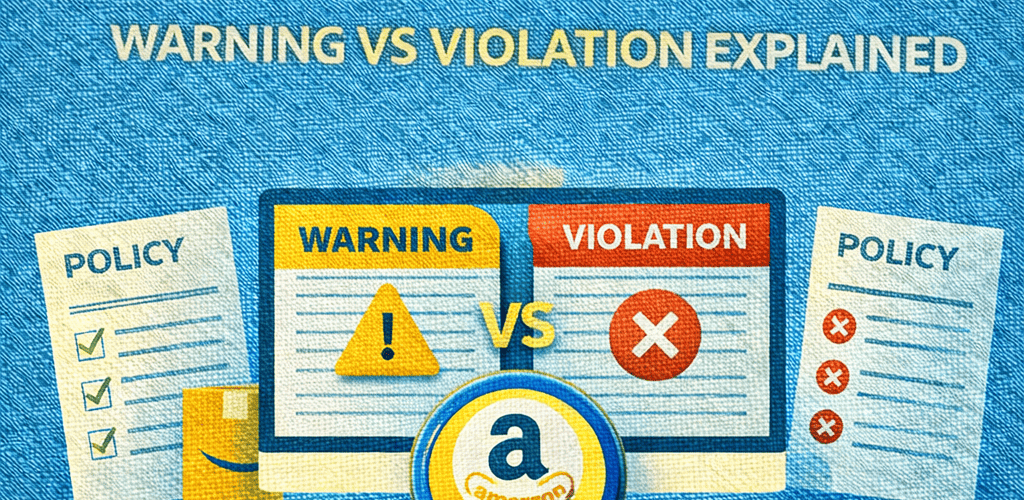
The primary difference between a policy warning and a policy violation lies in the level of certainty and enforcement involved.
A policy warning is essentially Amazon saying that something might be wrong. Amazon is giving the seller a chance to review the situation and fix the problem before it becomes more serious.
A policy violation, on the other hand, means Amazon has already determined that the seller broke a rule. At this point, Amazon typically enforces consequences such as listing removal, compliance requests, or account health penalties.
In simpler terms, a warning is a preventive notification, while a violation is a confirmed enforcement action.
Another key difference involves the impact on the seller’s account health. Warnings usually do not directly affect account health metrics. However, violations are recorded in the account health system and can contribute to account suspension if they accumulate over time.
Additionally, warnings rarely require formal appeals. Violations often require sellers to submit documentation, corrective actions, or a detailed Plan of Action explaining how the issue occurred and how it will be prevented in the future.
How Amazon Communicates These Alerts
Amazon communicates policy warnings and violations through several channels within Seller Central.
The most common place sellers see these alerts is the Performance Notifications section. This area contains messages related to listing issues, compliance alerts, intellectual property complaints, and account warnings.
Another important section is the Account Health Dashboard, which displays active violations affecting the seller’s account. This dashboard helps sellers track problems such as product policy violations, intellectual property complaints, and customer product condition complaints.
Amazon also sends email notifications to the registered seller account email address whenever an important policy issue occurs. These emails usually include a summary of the problem, the affected ASIN, and instructions for resolving the issue.
Sellers should check these areas regularly to ensure they do not miss important alerts.
How Sellers Should Respond to a Policy Warning
When a seller receives a policy warning, the best approach is to review the notification carefully and investigate the issue immediately.
The seller should identify which ASIN or listing Amazon is referring to and examine the listing content in detail. This includes reviewing the title, bullet points, description, images, and backend keywords.
If the listing contains potentially misleading claims, unauthorized brand references, or restricted keywords, the seller should update the content to remove those elements.
For example, if a listing contains medical claims that Amazon does not allow, the seller should edit the text to remove those claims and ensure the product description remains compliant with Amazon’s policies.
After correcting the issue, the seller should monitor the account health dashboard and performance notifications to ensure the problem does not escalate further.
Taking quick action in response to warnings demonstrates compliance and helps maintain a healthy seller account.
How Sellers Should Respond to a Policy Violation
When a policy violation occurs, sellers need to take the situation much more seriously. The first step is to understand the exact nature of the violation.
Sellers should carefully read the notification message and determine which policy was violated. The message usually includes the affected ASIN and the specific reason for the enforcement action.
If the issue involves intellectual property complaints, the seller may need to contact the brand owner to request a complaint retraction. Alternatively, the seller may need to provide authorization documents proving that they are allowed to sell the product.
If the violation involves product authenticity, Amazon may request supplier invoices. Sellers should ensure the invoices meet Amazon’s requirements, including supplier contact information, purchase quantities, and recent purchase dates.
In some cases, sellers must submit a Plan of Action explaining the root cause of the violation, the steps taken to fix the problem, and the preventive measures implemented to avoid similar issues in the future.
Providing clear documentation and a well-structured explanation significantly increases the chances of resolving the violation successfully.
Why Sellers Must Take Policy Alerts Seriously
Many Amazon sellers underestimate the importance of policy notifications. Some sellers ignore warnings because they believe no immediate action is required, while others panic when they see violations and respond without understanding the issue.
Both approaches can harm a seller’s business.
Warnings should be treated as opportunities to fix problems early before they escalate. Violations should be handled carefully and professionally to prevent long-term damage to the seller account.
Amazon’s marketplace is highly automated, and repeated policy issues can quickly lead to reduced account health and potential account suspension.
For sellers who rely on Amazon as a primary business channel, maintaining policy compliance is essential for long-term success.
Final Thoughts
Understanding the difference between Amazon policy warnings and policy violations is crucial for every seller. While both are related to policy compliance, they represent very different stages of enforcement.
A policy warning is essentially an early alert that something might be wrong, giving the seller the opportunity to correct the issue before Amazon takes action. A policy violation, however, means Amazon has confirmed a rule was broken and has already taken enforcement measures.
By responding quickly to warnings and handling violations properly, sellers can protect their listings, maintain strong account health, and avoid serious penalties such as listing suppression or account suspension.
In the competitive world of Amazon selling, compliance is not just a requirement it is a key part of building a sustainable and successful business.