

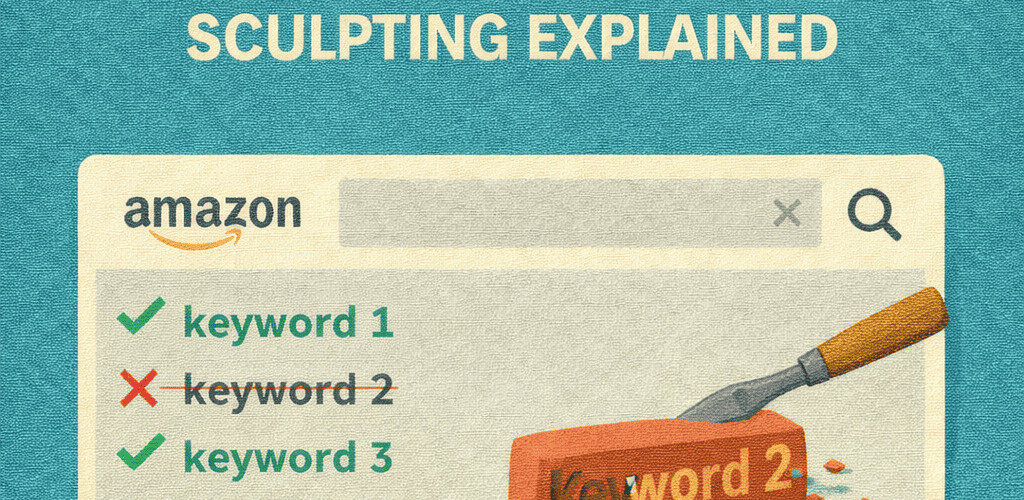
Amazon PPC negative keyword sculpting is one of the most powerful yet underutilized optimization strategies in Amazon advertising. While many sellers focus heavily on adding new keywords, experienced advertisers know that real profitability comes from controlling which search terms trigger which campaigns. Negative keyword sculpting is the process of intentionally blocking specific search terms in certain campaigns so that traffic is forced into the most relevant and best-optimized campaign structure.
This approach gives sellers control over Amazon’s algorithm rather than allowing it to distribute traffic randomly across auto, broad, phrase, and exact match campaigns. Without sculpting, the same keyword can appear in multiple campaigns at the same time, leading to internal competition, higher cost per click, and unstable performance.
Why Negative Keyword Sculpting Is Essential for Amazon PPC Success
Amazon’s advertising system does not prioritize match types in a strict hierarchy. An exact match keyword does not automatically override a broad or phrase keyword, which means Amazon can serve ads from less optimized campaigns if bids or relevance signals are stronger. This behavior often results in wasted ad spend and poor data clarity.
Negative keyword sculpting solves this problem by creating clear traffic boundaries. Each search term is guided into the campaign where it performs best, allowing sellers to bid accurately, analyze performance confidently, and scale winning keywords without distortion. Over time, this leads to lower ACOS, higher conversion rates, and more predictable growth.
How Traffic Flow Works in a Sculpted PPC Structure
A properly sculpted Amazon PPC account follows a discovery-to-precision traffic flow. Auto campaigns and broad match campaigns are used to discover new search terms. Phrase match campaigns help refine intent, while exact match campaigns are reserved for proven, high-performing keywords. Negative keywords act as gates that prevent traffic from flowing backward once a keyword has proven its value.
When a converting search term is identified in an auto or broad campaign, it should be promoted into an exact match campaign. At the same time, that keyword must be added as a negative exact keyword in all discovery campaigns. This ensures that future impressions for that term are handled only by the exact campaign, where bids, budgets, and performance are tightly controlled.
Role of Auto Campaigns in Negative Keyword Sculpting
Auto campaigns are ideal for keyword discovery but are also the most dangerous source of wasted spend if left unmanaged. Amazon automatically matches ads to search terms based on listing content and shopper behavior, which often leads to irrelevant clicks. Once a search term from an auto campaign begins converting consistently, it should be removed from the auto campaign using a negative exact keyword.
This allows the auto campaign to continue discovering new opportunities while preventing it from competing with manual campaigns for known winners. Over time, a well-sculpted auto campaign becomes a pure research engine rather than a primary sales driver.
Sculpting Broad Match Campaigns for Controlled Discovery
Broad match campaigns are useful for discovering keyword variations and long-tail queries, but they require strong negative keyword discipline. Without sculpting, broad campaigns can continue spending on keywords that already perform well in exact campaigns, which leads to cannibalization and inflated CPCs.
By adding negative exact keywords for all proven exact-match winners, broad campaigns are forced to focus only on new variations. This keeps data clean and ensures that spend is directed toward discovery rather than duplicating performance traffic.
Using Phrase Match Campaigns as a Bridge to Exact Match
Phrase match campaigns sit between broad and exact match in terms of control. They are often used to scale mid-intent keywords that are too specific for broad match but not yet fully isolated. Once a phrase keyword shows consistent conversions and stable ACOS, it should be moved into an exact match campaign.
At that point, adding the keyword as a negative exact in the phrase campaign ensures that traffic flows exclusively into the exact campaign. This gradual refinement process is a core principle of effective negative keyword sculpting.
Understanding Negative Exact vs Negative Phrase Keywords
Negative exact keywords block ads only when the search term exactly matches the keyword, making them ideal for traffic sculpting without restricting discovery. They are the safest and most commonly used option for isolating proven keywords.
Negative phrase keywords block any search term containing the phrase and are significantly more restrictive. While powerful, they should be used carefully and primarily for eliminating clearly irrelevant traffic or preventing overlap at a broader level. Overuse of negative phrase keywords can limit scale and suppress valuable variations.
Brand and Non-Brand Traffic Isolation Through Sculpting
Separating brand and non-brand traffic is another critical use case for negative keyword sculpting. Brand keywords typically convert at a much higher rate and require different bidding strategies than non-brand keywords. Mixing them in the same campaigns makes performance analysis unreliable.
By adding brand keywords as negative phrase keywords in non-brand campaigns, sellers can isolate brand traffic into dedicated campaigns. This improves reporting accuracy, protects brand visibility, and allows for more precise budget allocation.
How Negative Keyword Sculpting Protects Advertising Budgets
Unsculpted campaigns often allow high-spend discovery campaigns to drain budgets early in the day, leaving profitable exact match campaigns underfunded. Negative keyword sculpting prevents this by ensuring that high-intent keywords are reserved exclusively for performance-driven campaigns.
This budget protection is especially important during high-traffic periods, such as peak sales seasons or deal events, where inefficient traffic distribution can quickly erode profitability.
Timing and Best Practices for Adding Negative Keywords
Effective sculpting requires patience and data-driven decision-making. Keywords should not be negated after only a few clicks. Instead, sellers should wait until enough data is available to confirm consistent performance trends. Once negative keywords are added, campaigns should be monitored for at least one to two weeks to assess impact before making additional changes.
Frequent, reactive updates can disrupt Amazon’s learning process and make it difficult to measure true performance improvements.
Why Negative Keyword Sculpting Separates Professionals from Beginners
Negative keyword sculpting transforms Amazon PPC from a reactive system into a controlled, scalable strategy. It creates clarity, reduces wasted spend, and allows sellers to confidently scale what works. While it requires discipline and ongoing maintenance, the long-term benefits far outweigh the effort.
For sellers struggling with high ACOS, unstable results, or confusing data, negative keyword sculpting is often the missing link. When applied correctly, it gives you control over your advertising ecosystem and turns Amazon PPC into a predictable driver of profitable growth.
Conclusion
Amazon PPC negative keyword sculpting is not a one-time optimization task it is an ongoing discipline that determines whether your advertising account remains profitable as it scales. By intentionally controlling where search terms appear, you eliminate internal competition between campaigns, reduce wasted ad spend, and gain clear, reliable performance data. Instead of letting Amazon’s algorithm distribute traffic unpredictably, sculpting allows you to define a structured path from discovery to conversion.
As your campaigns mature, negative keyword sculpting ensures that high-performing keywords are protected inside exact match campaigns where bids, budgets, and profitability can be tightly managed. At the same time, discovery campaigns remain clean and efficient, focused solely on uncovering new opportunities rather than draining spend on proven terms. This balance is what leads to stable ACOS, stronger conversion rates, and sustainable growth.
Ultimately, sellers who master negative keyword sculpting move beyond guesswork and reactive optimization. They build PPC systems that are scalable, measurable, and resilient to changes in competition or seasonality. If your goal is long-term profitability and full control over your Amazon advertising performance, negative keyword sculpting is not optional it is essential.
Leave A Comment