

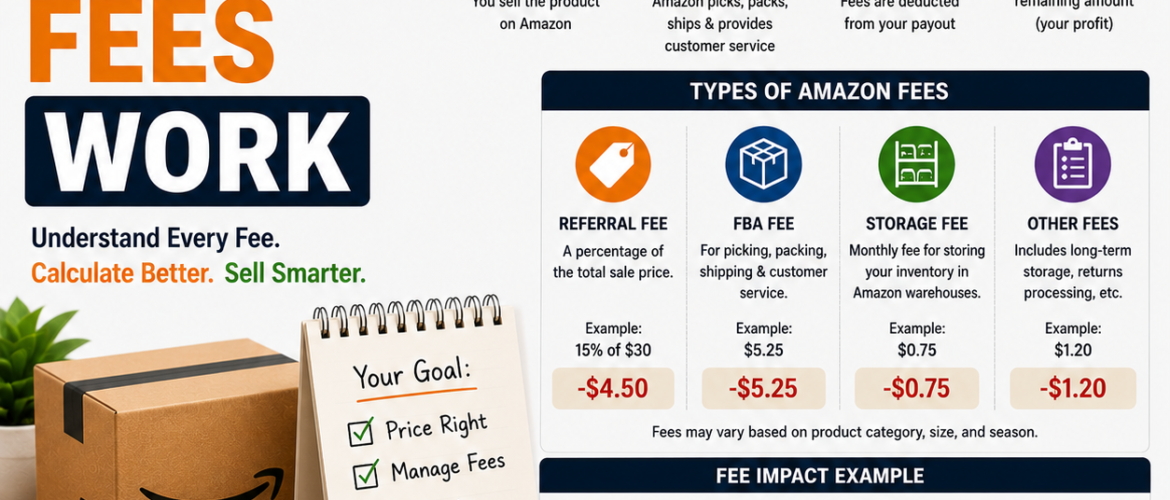
Before sellers can start selling on Amazon, they must choose a selling plan. Amazon currently offers two primary plans: the Individual Plan and the Professional Plan.
Individual Selling Plan
The Individual plan is designed for people who sell a small number of products each month. Instead of paying a monthly subscription fee, sellers pay a per-item fee every time a product sells.
This plan is ideal for:
- Beginners testing Amazon FBA
- Casual sellers
- Small businesses with limited inventory
- People selling fewer than 40 products per month
For every item sold, Amazon charges approximately $0.99 in addition to other selling fees.
Although this plan has lower upfront costs, it comes with limitations.
Individual sellers usually cannot access:
- Advanced advertising features
- Bulk product upload tools
- Detailed business reports
- API integrations
- Certain restricted categories
Because of these limitations, most serious Amazon businesses eventually upgrade to the Professional plan.
Professional Selling Plan
The Professional plan is built for businesses that want to scale aggressively on Amazon.
Instead of paying per item sold, sellers pay a fixed monthly subscription fee, which is usually around $39.99/month in the US marketplace.
This plan provides access to powerful business tools such as:
- Amazon PPC advertising
- Brand Registry features
- Advanced analytics
- Bulk listing uploads
- Promotions and coupons
- Inventory management tools
- Buy Box eligibility improvements
For sellers moving serious volume, the Professional plan is almost always more cost-effective.
For example:
If you sell 100 products monthly using the Individual plan, you may pay around:
100 × $0.99 = $99
In comparison, the Professional plan remains around $39.99 regardless of sales volume.
This is why nearly all private label sellers use the Professional account.
Amazon Referral Fees (Detailed Explanation)
Referral fees are one of Amazon’s largest and most important charges.
Amazon charges a percentage commission every time a product sells.
This fee is essentially Amazon’s payment for providing:
- Marketplace traffic
- Customer access
- Platform infrastructure
- Payment processing
- Customer trust
- Search visibility
Referral fees vary depending on the product category.
How Referral Fees Are Calculated
Amazon calculates referral fees as a percentage of the total selling price.
This usually includes:
- Product price
- Shipping charges
- Gift wrapping charges
The average referral fee across most categories is approximately 15%, although some categories are lower or higher.
Example of Referral Fee Calculation
Suppose you sell a product for $50.
If the referral fee is 15%, Amazon deducts:
$50 × 15% = $7.50
This means before considering FBA fees or advertising costs, Amazon already keeps $7.50 from the sale.
Categories with Higher Referral Fees
Certain categories have significantly different referral fee structures.
Examples include:
Jewelry
Jewelry categories may have higher commissions because of higher product values.
Amazon Device Accessories
Sometimes lower fee structures apply.
Apparel and Fashion
Fashion products often include moderate referral fees along with high return rates.
Beauty and Personal Care
Beauty products generally have standard referral fees but require careful profitability calculations due to advertising competition.
Books and Media
Books often include additional fixed closing fees.
Understanding category-specific referral fees is critical before selecting a product niche.
Amazon FBA Fulfillment Fees (Detailed Explanation)
Fulfillment by Amazon (FBA) allows sellers to store inventory inside Amazon warehouses while Amazon handles:
- Picking
- Packing
- Shipping
- Customer service
- Returns management
This convenience comes with fulfillment fees.
These fees are among the largest operating expenses for FBA sellers.
What Determines FBA Fulfillment Fees?
Amazon calculates fulfillment fees primarily using:
- Product dimensions
- Shipping weight
- Packaging size
- Product category
- Dimensional weight
Small and lightweight products are generally much more profitable because fulfillment fees remain lower.
Standard Size vs Oversize Products
Amazon divides products into different fulfillment size tiers.
Standard-Size Products
These are smaller, lighter products.
Advantages include:
- Lower FBA fees
- Lower storage costs
- Easier shipping
- Better profit margins
Oversize Products
These products are larger or heavier.
Oversized products usually have:
- Higher shipping fees
- Higher storage fees
- Lower margins
- More return complications
Many beginner sellers fail because they underestimate oversized product costs.
Why Packaging Optimization Matters
Even small packaging changes can reduce fulfillment fees significantly.
For example:
Reducing a product’s package dimensions by even half an inch may move it into a lower fee tier.
This can save thousands of dollars annually.
Smart sellers constantly optimize:
- Box size
- Product folding
- Protective inserts
- Packaging materials
to reduce fulfillment costs.
Monthly Storage Fees (Detailed Explanation)
Amazon charges storage fees for inventory stored in its warehouses.
These fees are calculated based on the amount of warehouse space your inventory occupies.
Storage fees are charged monthly.
Why Storage Fees Matter So Much
Storage costs may seem small initially, but they can become massive when:
- Inventory does not sell quickly
- Sellers overstock
- Seasonal products remain unsold
- Demand forecasting fails
Storage fees can slowly destroy profitability over time.
Peak Season Storage Costs
During Q4 (October–December), Amazon dramatically increases storage fees.
This happens because warehouse space becomes extremely valuable during holiday shopping seasons.
Sellers who carry excessive inventory during Q4 may experience very high storage bills.
Inventory Turnover Importance
One of the best ways to reduce storage fees is improving inventory turnover.
Inventory turnover means:
How quickly products sell and leave Amazon warehouses.
Healthy inventory turnover helps sellers:
- Maintain cash flow
- Reduce long-term fees
- Improve storage efficiency
- Increase profitability
Fast-moving products are usually more sustainable long-term.
Long-Term Storage Fees (Detailed Explanation)
Amazon penalizes sellers for storing inventory too long.
Products sitting in warehouses for extended periods generate additional long-term storage fees.
These fees encourage sellers to maintain efficient inventory management.
Why Long-Term Storage Is Dangerous
Many sellers assume unsold inventory is harmless.
However, slow-moving inventory creates multiple business problems:
- Storage costs accumulate monthly
- Cash flow becomes restricted
- Ranking declines due to low sales velocity
- Inventory may become outdated
- Seasonal demand may disappear
Long-term storage fees often force sellers to liquidate inventory at a loss.
Common Causes of Excess Inventory
Poor Product Research
Selecting low-demand products often creates dead inventory.
Overordering Inventory
Many sellers order too much inventory too early.
Weak PPC Strategy
Low traffic results in slow inventory movement.
Poor Listing Optimization
Bad images and weak copy reduce conversion rates.
Seasonal Products
Holiday items may stop selling after peak season.
Amazon PPC Advertising Fees (Detailed Explanation)
Amazon PPC is one of the most powerful growth tools available to sellers.
However, it is also one of the largest operational expenses.
PPC stands for Pay-Per-Click.
This means sellers pay every time shoppers click their ads.
Why PPC Is Necessary
Amazon has become highly competitive.
Without advertising, new products often struggle to gain visibility.
PPC helps sellers:
- Generate traffic
- Increase sales velocity
- Rank organically
- Launch products faster
- Defend branded keywords
Most successful Amazon brands invest heavily in advertising.
Sponsored Products Ads
These are keyword-targeted ads appearing inside Amazon search results.
They are the most commonly used PPC format.
Sponsored Products help sellers target:
- Exact keywords
- Broad keywords
- Competitor ASINs
- Category traffic
These ads are essential for product launches.
Sponsored Brands Ads
Sponsored Brands allow businesses to display:
- Brand logos
- Multiple products
- Custom headlines
These ads improve:
- Brand visibility
- Store traffic
- Customer trust
Sponsored Brands are particularly effective for brands with multiple products.
Sponsored Display Ads
Sponsored Display helps sellers retarget customers both on and off Amazon.
These ads can:
- Re-engage previous visitors
- Target competitor audiences
- Increase repeat purchases
This format has become increasingly important for advanced Amazon advertising strategies.
Understanding ACOS and TACOS
Two critical advertising metrics are:
ACOS (Advertising Cost of Sales)
Measures direct ad efficiency.
TACOS (Total Advertising Cost of Sales)
Measures total advertising impact on overall revenue.
Healthy PPC management requires balancing:
- Profitability
- Organic growth
- Keyword ranking
- Brand visibility
Return Processing Fees (Detailed Explanation)
Customer returns are a major hidden expense for Amazon sellers.
Some categories experience extremely high return rates.
Examples include:
- Apparel
- Shoes
- Electronics
- Beauty
- Seasonal products
Amazon may charge return processing fees when customers send products back.
Why Returns Hurt Profitability
Returns create multiple financial losses simultaneously.
Shipping Costs
Amazon still incurs shipping expenses.
Damaged Inventory
Returned items may become unsellable.
Customer Refunds
Revenue disappears while operational costs remain.
Disposal Costs
Unsellable products may require disposal.
Inventory Loss
Some returned products cannot be resold as new.
High return rates can completely destroy profit margins.
How Sellers Reduce Return Rates
Successful sellers reduce returns by improving:
- Product quality
- Listing accuracy
- Image clarity
- Sizing charts
- Customer expectations
- Packaging protection
Better customer
Conclusion
Understanding Amazon fees is crucial for running a profitable Amazon business. From referral and FBA fees to storage and PPC costs, every expense affects your profit margins. Sellers who carefully manage costs, optimize inventory, and improve advertising efficiency are more likely to succeed long term on Amazon.
For expert Amazon FBA support and growth strategies, visit Moiz IT Official Website