

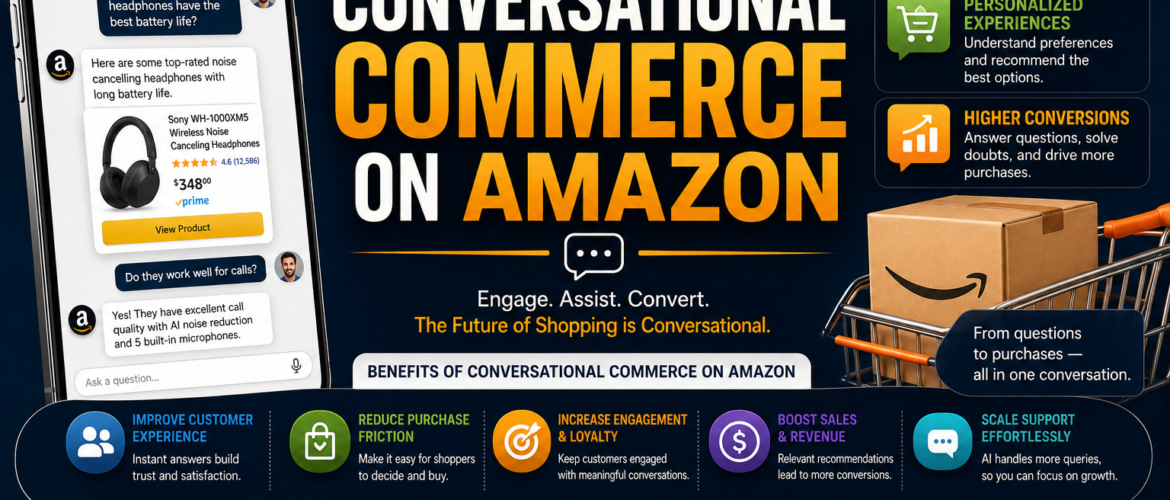
The eCommerce industry has undergone remarkable transformations over the past two decades. From simple online catalogs to personalized shopping experiences, technological innovation continues to redefine how consumers discover, evaluate, and purchase products. One of the most significant developments in recent years is Conversational Commerce the integration of messaging, voice technology, artificial intelligence (AI), and chat-based interactions into the shopping journey.
As the world’s largest online marketplace, Amazon is at the forefront of this evolution. Through AI-powered assistants, voice shopping capabilities, personalized recommendations, and generative AI technologies, Amazon is creating a more intuitive, interactive, and customer-centric shopping experience.
This article explores conversational commerce on Amazon, its benefits, key technologies, real-world applications, challenges, and what the future holds for online retail.
What is Conversational Commerce?
Conversational commerce refers to the use of conversational interfaces such as chatbots, virtual assistants, voice assistants, and messaging platforms to facilitate shopping experiences. Instead of navigating through traditional menus and search filters, customers interact with AI-powered systems using natural language.
Examples include:
- Asking a chatbot for product recommendations
- Using voice commands to search for products
- Receiving personalized shopping suggestions
- Getting instant answers about products and orders
- Completing purchases through conversational interfaces
The goal is to make shopping feel more like interacting with a knowledgeable sales associate rather than browsing a website.
Amazon’s Journey Toward Conversational Commerce
Amazon has consistently invested in technologies that simplify customer interactions. The company’s journey into conversational commerce began with the introduction of Alexa, but has since expanded into multiple AI-driven shopping experiences.
Key milestones include:
1. Alexa Voice Shopping
Launched through Amazon Echo devices, Alexa enabled users to:
- Search for products
- Add items to shopping carts
- Reorder previous purchases
- Track deliveries
- Receive product recommendations
Customers could simply say:
“Alexa, order paper towels.”
This marked one of the earliest mainstream implementations of conversational commerce.
2. AI-Powered Product Discovery
Amazon gradually enhanced its recommendation engine using machine learning algorithms that analyze:
- Purchase history
- Browsing behavior
- Customer preferences
- Product reviews
- Shopping patterns
This allowed Amazon to deliver increasingly personalized shopping experiences.
3. Generative AI Shopping Assistants
Recent advancements in generative AI have enabled Amazon to offer more natural and context-aware shopping conversations.
Instead of searching:
“wireless headphones”
Customers can ask:
“What are the best wireless headphones for working out under $100?”
The AI understands intent, budget, usage scenarios, and preferences to provide relevant recommendations.
Key Components of Conversational Commerce on Amazon
Natural Language Processing (NLP)
Natural Language Processing allows Amazon’s AI systems to understand customer queries written or spoken in everyday language.
For example:
Customer Query:
“I need a laptop for graphic design and video editing.”
Traditional search systems may struggle to interpret this intent accurately.
Conversational AI identifies:
- Product category (laptop)
- Primary use case (graphic design)
- Secondary use case (video editing)
- Performance requirements
The result is more precise product recommendations.
Voice Commerce Through Alexa
Voice commerce remains one of Amazon’s strongest conversational commerce channels.
Benefits include:
Hands-Free Shopping
Customers can:
- Shop while cooking
- Reorder household essentials
- Check delivery status
- Create shopping lists
Accessibility
Voice shopping improves accessibility for:
- Elderly users
- Visually impaired customers
- Users with mobility limitations
Faster Repeat Purchases
Frequently purchased products can be reordered in seconds.
AI Shopping Assistants
Amazon’s AI assistants act like digital shopping advisors.
They help customers:
- Compare products
- Understand specifications
- Evaluate alternatives
- Discover new products
- Make informed decisions
Instead of reading hundreds of reviews, customers can ask:
“Which coffee maker is best for a small family?”
The AI summarizes relevant information and presents suitable options.
Personalized Recommendations
Conversational commerce thrives on personalization.
Amazon leverages:
- Purchase history
- Browsing behavior
- Wish lists
- Product interactions
- Demographic insights
To create customized shopping experiences.
Examples include:
- Product suggestions
- Bundle recommendations
- Seasonal promotions
- Cross-selling opportunities
The more customers interact with Amazon, the smarter the recommendations become.
Benefits of Conversational Commerce on Amazon
Enhanced Customer Experience
Customers receive immediate assistance without searching through multiple pages.
Benefits include:
- Faster decision-making
- Reduced search effort
- Personalized guidance
- Improved satisfaction
Increased Conversion Rates
When shoppers receive relevant recommendations and quick answers, they are more likely to complete purchases.
Conversational commerce helps reduce:
- Shopping friction
- Product uncertainty
- Cart abandonment
Leading to higher conversion rates.
Better Product Discovery
Many customers struggle to find products that meet their exact needs.
Conversational interfaces allow users to describe requirements naturally:
“I need a lightweight backpack for international travel.”
The system can then recommend highly relevant products.
Stronger Customer Engagement
Interactive conversations create deeper engagement compared to traditional search-based shopping.
Customers spend more time exploring products and interacting with Amazon’s ecosystem.
Improved Customer Support
AI-powered conversational systems can answer common questions such as:
- Where is my order?
- What is the return policy?
- Is this product compatible with my device?
- When will my package arrive?
This reduces customer service workload while improving response times.
How Sellers Benefit from Conversational Commerce
Amazon sellers can also gain significant advantages.
Higher Visibility
Products that match conversational queries effectively can gain more exposure.
Optimized product listings improve discoverability through AI recommendations.
Better Customer Understanding
Conversational interactions generate valuable insights about:
- Customer preferences
- Common questions
- Purchase motivations
- Product concerns
Sellers can use this data to improve listings and products.
Increased Sales Opportunities
AI recommendations often suggest complementary products.
Examples include:
- Cameras with memory cards
- Laptops with accessories
- Fitness equipment with supplements
This creates additional revenue opportunities.
Challenges of Conversational Commerce on Amazon
Despite its advantages, conversational commerce presents several challenges.
Accuracy of AI Recommendations
AI systems may occasionally misunderstand customer intent.
For example:
A customer looking for a budget-friendly option may receive premium recommendations.
Continuous training and refinement are necessary.
Privacy Concerns
Customers increasingly care about how their data is collected and used.
Amazon must balance personalization with:
- Data protection
- Transparency
- Regulatory compliance
Maintaining customer trust remains essential.
Complex Product Categories
Some purchases require extensive research.
Examples include:
- Medical devices
- Enterprise software
- Professional equipment
Conversational AI may not always replace detailed human consultation.
Voice Recognition Limitations
Voice assistants can sometimes misinterpret:
- Accents
- Background noise
- Complex requests
Improving speech recognition remains a key priority.
The Future of Conversational Commerce on Amazon
The future promises even more advanced shopping experiences.
Hyper-Personalized Shopping
Future AI systems will understand:
- Lifestyle preferences
- Shopping habits
- Contextual needs
- Long-term purchasing behavior
Recommendations will become increasingly tailored to individual customers.
Multimodal Shopping Experiences
Customers will interact through:
- Voice
- Text
- Images
- Video
For example:
A customer could upload a photo of a chair and ask:
“Find similar products under $200.”
AI would analyze the image and provide matching recommendations.
Proactive Shopping Assistants
Future assistants may proactively suggest purchases based on:
- Usage patterns
- Subscription schedules
- Seasonal needs
For example:
“Your dog food supply may run out next week. Would you like to reorder?”
More Human-Like Conversations
Advances in generative AI will create increasingly natural interactions.
Customers will engage in detailed conversations that resemble interactions with experienced retail consultants.
Conclusion
Conversational commerce is reshaping the future of online retail, and Amazon is leading this transformation through AI-powered shopping assistants, voice commerce, personalized recommendations, and generative AI technologies. By enabling customers to interact naturally through voice and chat, Amazon is reducing friction, improving product discovery, and delivering highly personalized shopping experiences.
As artificial intelligence continues to evolve, conversational commerce will become an even more integral part of the customer journey. The future of eCommerce is not just about searching for products—it is about having meaningful, intelligent conversations that help customers find exactly what they need. Amazon’s ongoing investment in conversational commerce positions it as a key driver of the next generation of digital shopping experiences.