

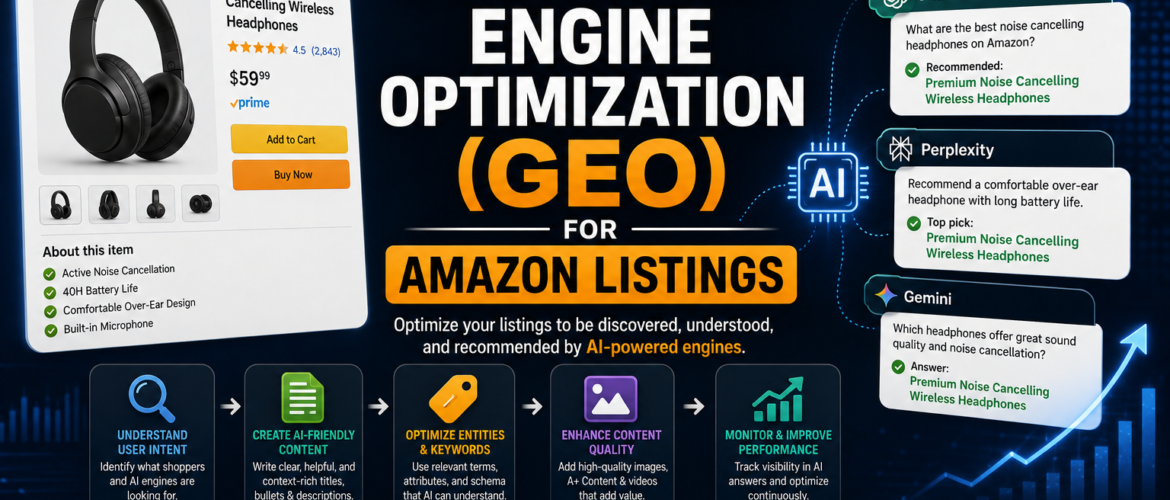
Amazon sellers have spent years optimizing product listings for traditional search algorithms. Keywords, backend search terms, A+ Content, and PPC campaigns have long been the foundation of Amazon listing optimization. However, a major shift is happening in eCommerce search.
Artificial Intelligence is transforming how shoppers discover products online. Instead of typing simple keywords like “best water bottle,” consumers are increasingly asking AI-powered assistants detailed questions such as:
- What is the best insulated water bottle for hiking?
- Which water bottle keeps drinks cold for 24 hours?
- What is the most durable stainless steel water bottle under $30?
As AI-driven search experiences become more common, sellers must adapt their optimization strategies. This is where Generative Engine Optimization (GEO) comes into play.
GEO is the process of optimizing content so AI-powered search engines and generative AI systems can understand, recommend, and surface your products when answering user questions.
For Amazon sellers, GEO represents the next evolution beyond traditional Amazon SEO.
What Is Generative Engine Optimization (GEO)?
Generative Engine Optimization (GEO) is the practice of optimizing content for AI-generated search results rather than traditional keyword-based rankings.
Traditional SEO focuses on helping search engines rank your content.
GEO focuses on helping AI systems understand your content and use it as a trusted source when generating answers.
Examples of AI-driven platforms include:
- ChatGPT
- Google AI Overviews
- Microsoft Copilot
- Amazon Rufus
- Perplexity AI
- Gemini
Instead of showing a list of links, these systems provide direct answers generated from multiple sources.
For Amazon sellers, GEO means creating listings that AI can easily interpret, trust, and recommend.
Why GEO Matters for Amazon Sellers
Amazon is already integrating AI into the shopping experience.
The most notable example is Amazon’s AI shopping assistant, Rufus, which helps customers find products through conversational searches.
Rather than searching:
“camping lantern”
Customers may ask:
- Which camping lantern is best for emergency preparedness?
- What camping lantern lasts all night on one charge?
- Which lantern is waterproof and suitable for backpacking?
AI systems analyze product listings and generate recommendations based on available information.
If your listing clearly answers these questions, your product has a higher chance of being recommended.
This creates a major competitive advantage for sellers who optimize for GEO.
GEO vs Traditional Amazon SEO
| Traditional Amazon SEO | Generative Engine Optimization |
|---|---|
| Focuses on keywords | Focuses on meaning and context |
| Optimizes for rankings | Optimizes for AI recommendations |
| Targets search volume | Targets user intent |
| Keyword density matters | Content quality matters |
| Short keyword phrases | Natural language answers |
| Search engine visibility | AI visibility |
Traditional SEO remains important, but GEO adds another layer that helps products appear in AI-generated recommendations.
How AI Understands Amazon Listings
AI systems evaluate listings differently than traditional search algorithms.
They analyze:
Product Purpose
What problem does the product solve?
Example:
Instead of simply identifying a product as a “foam roller,” AI may understand it as:
“A muscle recovery tool designed for athletes, runners, and fitness enthusiasts.”
Customer Benefits
AI focuses heavily on outcomes.
For example:
Instead of:
“Stainless steel construction”
AI understands:
“Provides long-lasting durability and resistance to rust.”
User Scenarios
AI attempts to match products with specific situations.
Examples:
- Home workouts
- Camping trips
- Office use
- Travel
- Pet training
- Elderly care
The more clearly these scenarios are described, the easier it becomes for AI to recommend the product.
How to Optimize Amazon Listings for GEO
1. Write Customer-Centric Titles
Traditional titles often focus heavily on keywords.
Example:
“Water Bottle Stainless Steel Vacuum Insulated 32oz Leakproof Sports Bottle”
A GEO-friendly version emphasizes context:
“32oz Stainless Steel Insulated Water Bottle for Hiking, Travel, Gym, and Outdoor Adventures”
The second version helps AI understand:
- Product type
- Use cases
- Target audience
- Benefits
2. Create Detailed Bullet Points
Many sellers waste bullet points by repeating keywords.
Instead, answer potential customer questions.
Example:
Weak Bullet Point
“Premium Stainless Steel Construction”
GEO-Optimized Bullet Point
“Made from food-grade stainless steel that resists rust, dents, and everyday wear while maintaining beverage temperature throughout the day.”
This provides meaningful context AI can use.
3. Focus on Real Customer Problems
AI models prioritize solutions.
Ask yourself:
- What frustration does this product solve?
- Why would someone buy it?
- What outcome does the customer want?
Example:
Instead of:
“Adjustable resistance bands”
Use:
“Allows users to customize workout intensity for strength training, rehabilitation, and home fitness routines.”
4. Add Use Cases Throughout the Listing
AI frequently recommends products based on situations.
Include use cases such as:
- Travel
- Camping
- Hiking
- Home office
- College students
- Small apartments
- Pet owners
- Parents
Example:
“This portable fan is ideal for camping, outdoor sports events, travel, dorm rooms, and emergency backup cooling.”
5. Optimize A+ Content for Context
A+ Content is often underutilized.
Many sellers focus only on visual design.
For GEO, include:
- Product applications
- Problem-solving benefits
- Feature explanations
- Comparisons
- Customer scenarios
Rich contextual content improves AI understanding.
6. Answer Frequently Asked Questions
FAQ-style content aligns perfectly with generative search.
Examples:
Question:
How long does the battery last?
Answer:
The rechargeable battery provides up to 18 hours of continuous operation depending on brightness settings.
Question:
Is it suitable for outdoor use?
Answer:
Yes, the lantern features water-resistant construction designed for camping and emergency preparedness.
This structure mirrors how users interact with AI assistants.
7. Use Natural Language Keywords
AI understands natural language much better than older search algorithms.
Instead of stuffing:
- camping lantern
- LED lantern
- rechargeable lantern
Use natural sentences:
“This rechargeable LED lantern is designed for campers, hikers, and emergency preparedness kits.”
The listing remains keyword-rich while becoming more readable.
8. Build Authority and Trust
AI systems prefer trustworthy products.
Improve:
- Product reviews
- Brand reputation
- Accurate descriptions
- High-quality images
- Comprehensive product information
Trust signals increase the likelihood of recommendations.
GEO and Amazon Rufus
Amazon’s Rufus is one of the clearest examples of GEO in action.
Rufus helps shoppers by:
- Comparing products
- Answering product questions
- Recommending products
- Explaining features
- Suggesting alternatives
To appear in Rufus-generated recommendations, listings should clearly communicate:
- Features
- Benefits
- Applications
- Customer use cases
- Product differentiation
The more complete your product information is, the better Rufus can understand and recommend it.
Common GEO Mistakes Amazon Sellers Make
Keyword Stuffing
AI prioritizes readability and meaning over excessive keyword repetition.
Vague Bullet Points
Generic statements provide little context for AI systems.
Missing Use Cases
Without scenarios, AI struggles to match products to shopper needs.
Ignoring Customer Questions
Many listings fail to answer the questions buyers actually ask.
Thin A+ Content
Minimal content reduces AI understanding and recommendation opportunities.
GEO Content Framework for Amazon Listings
Use this simple framework:
What Is It?
Clearly describe the product.
Who Is It For?
Identify the target audience.
What Problem Does It Solve?
Explain customer pain points.
How Does It Work?
Describe functionality.
When Should It Be Used?
Include real-world scenarios.
Why Is It Better?
Highlight differentiators.
This framework creates AI-friendly content that improves both conversions and discoverability.
The Future of Amazon Listing Optimization
The future of eCommerce search is moving toward conversation rather than keywords.
Consumers increasingly expect:
- Direct answers
- Personalized recommendations
- AI-generated shopping assistance
As Amazon expands AI-powered features, sellers who adopt GEO early will gain a competitive advantage.
Traditional SEO is not disappearing, but GEO is becoming an essential complement.
Successful Amazon sellers will optimize for both search algorithms and AI recommendation engines.
Conclusion
Generative Engine Optimization (GEO) is rapidly becoming one of the most important concepts in Amazon listing optimization. As AI shopping assistants like Rufus become more influential, sellers must shift from simply targeting keywords to creating content that clearly communicates context, benefits, use cases, and customer solutions.
Listings that answer real customer questions, explain product value, and provide meaningful context are more likely to be understood and recommended by AI systems. By combining traditional Amazon SEO with GEO principles, sellers can improve visibility, increase conversions, and prepare their businesses for the future of AI-powered eCommerce search.