

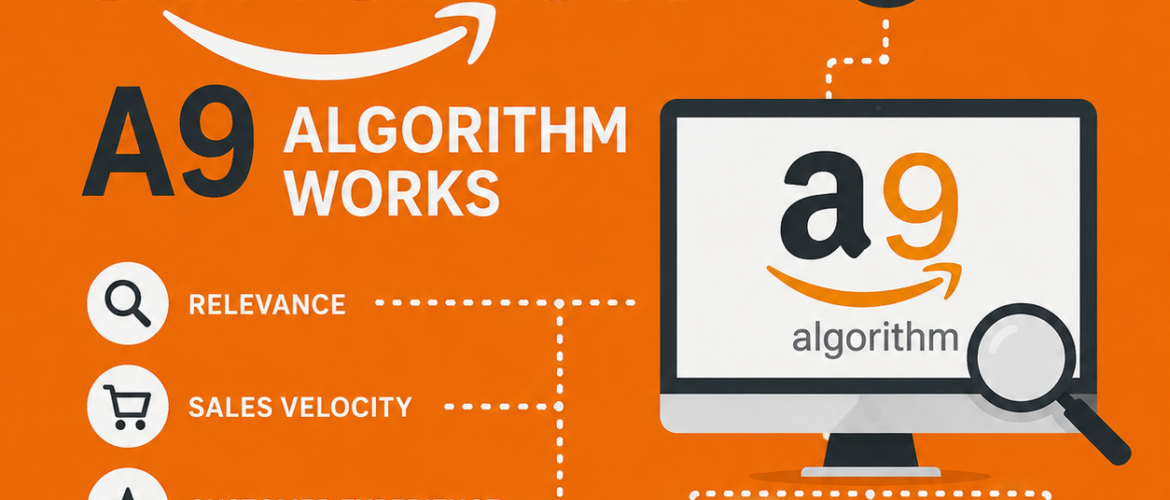
Selling on Amazon is no longer just about listing a product and waiting for sales. With millions of sellers competing for visibility, understanding how the Amazon A9 algorithm works has become essential for success.
If you want your products to rank higher, get more traffic, and increase sales, you need to understand how Amazon decides which products appear first in search results.
In this detailed guide, we’ll break down the Amazon A9 algorithm in simple terms, explain the ranking factors, and show you how to optimize your listings for better organic rankings.
What Is the Amazon A9 Algorithm?
The Amazon A9 algorithm is Amazon’s search engine ranking system. It determines which products appear when shoppers search for keywords on Amazon.
For example, when someone searches:
- “wireless earbuds”
- “dog leash”
- “yoga mat”
Amazon’s A9 algorithm analyzes thousands of products and decides:
- Which products are most relevant
- Which products are most likely to convert into sales
- Which products should rank at the top
Unlike Google, Amazon’s main goal is not information — it’s sales.
Amazon wants to show products that customers are most likely to buy.
That’s why the A9 algorithm focuses heavily on conversion performance and sales history.
Why Amazon A9 Algorithm Matters
If your product ranks on:
- Page 1 → High visibility and more sales
- Page 2 or lower → Very low traffic
Studies consistently show that most shoppers never go beyond the first page of Amazon results.
This means ranking higher directly impacts:
- Organic sales
- PPC performance
- Brand visibility
- Revenue growth
- Product launch success
Understanding the A9 algorithm gives sellers a major competitive advantage.
How Amazon A9 Algorithm Works
The Amazon A9 algorithm works in two major stages:
1. Relevancy Filtering
Amazon first identifies which products are relevant to the customer’s search query.
For example, if a customer searches:
“stainless steel water bottle”
Amazon checks listings for relevant keywords in:
- Product title
- Bullet points
- Backend search terms
- Product description
- Brand name
- Attributes
Products that are not relevant are filtered out.
2. Performance Ranking
After relevancy filtering, Amazon ranks products based on performance metrics such as:
- Conversion rate
- Sales velocity
- Click-through rate
- Reviews
- Pricing competitiveness
- Customer satisfaction
The products most likely to generate sales rank higher.
Major Amazon A9 Ranking Factors
Let’s explore the most important ranking factors in detail.
1. Keyword Relevance
Keyword relevance is the foundation of Amazon SEO.
Amazon needs to understand what your product is about.
Where Keywords Matter
Product Title
The title is one of the strongest ranking factors.
Your primary keyword should appear naturally in the title.
Bullet Points
Bullet points help Amazon understand product features and relevance.
Backend Search Terms
Hidden keywords placed in Seller Central help index additional search terms.
Product Description
Descriptions support indexing and improve conversions.
Product Attributes
Category, color, size, material, and other attributes help relevance matching.
Example
If you sell a camping lantern, your listing should include keywords like:
- LED camping lantern
- rechargeable lantern
- emergency light
- outdoor lantern
- hiking lantern
This helps Amazon connect your product to customer searches.
2. Sales Velocity
Sales velocity means how fast your product sells.
Amazon strongly favors products with:
- Consistent daily sales
- Strong recent sales history
- Growing demand trends
A product generating 30 sales per day will usually rank higher than a product generating 3 sales per day.
Why Sales Velocity Matters
Amazon sees high sales as proof that customers like the product.
More sales = more trust from Amazon.
This creates a powerful ranking cycle:
Higher rank → More visibility → More sales → Better rank
3. Conversion Rate (CVR)
Conversion rate is one of the most powerful A9 factors.
It measures how many visitors actually buy your product.
Formula
Conversion Rate=OrdersVisitors×100\text{Conversion Rate} = \frac{\text{Orders}}{\text{Visitors}} \times 100
Example
- 100 visitors
- 15 purchases
Conversion rate = 15%
Amazon prefers products with higher conversion rates because they generate more revenue.
How to Improve Conversion Rate
Optimize Product Images
Use:
- High-resolution images
- Lifestyle photos
- Infographics
- Close-up detail shots
- Comparison images
Write Better Copy
Focus on:
- Benefits
- Emotional triggers
- Problem-solving
- Clear formatting
Improve Reviews
Products with strong reviews convert better.
Competitive Pricing
Overpriced products often struggle to convert.
4. Click-Through Rate (CTR)
CTR measures how many shoppers click your listing after seeing it in search results.
Formula
CTR=ClicksImpressions×100\text{CTR} = \frac{\text{Clicks}}{\text{Impressions}} \times 100
A higher CTR tells Amazon:
“Customers are interested in this product.”
Factors That Improve CTR
Main Image
Your main image heavily affects clicks.
Winning images usually:
- Look professional
- Stand out visually
- Clearly show the product
- Follow Amazon guidelines
Product Title
A compelling title improves click probability.
Ratings & Reviews
Higher star ratings increase shopper trust.
Pricing
Competitive pricing attracts more clicks.
5. Customer Reviews and Ratings
Reviews are critical for both ranking and conversions.
Amazon favors products with:
- High ratings
- Positive feedback
- Consistent review growth
- Authentic customer engagement
How Reviews Affect A9
Reviews influence:
- Buyer trust
- Conversion rate
- Click-through rate
- Long-term ranking stability
Products with:
- 4.5+ stars
- Hundreds of reviews
usually outperform weaker competitors.
6. Product Pricing
Amazon wants shoppers to find competitive deals.
If your product is significantly overpriced compared to competitors, rankings may suffer.
Amazon compares:
- Similar products
- Historical pricing
- Market competitiveness
7. Fulfillment Method (FBA vs FBM)
Amazon FBA products often rank better because they offer:
- Faster shipping
- Prime eligibility
- Better customer experience
FBA can improve:
- Conversion rates
- Buy Box win rate
- Customer trust
8. Inventory Availability
Running out of stock can severely damage rankings.
When inventory goes unavailable:
- Sales stop
- Ranking drops
- Keyword positions decline
Recovering rankings after stockouts can take weeks or months.
9. Product Listing Quality
High-quality listings improve customer experience and conversion rates.
Amazon evaluates:
- Image quality
- Copy quality
- Listing completeness
- Mobile optimization
- Enhanced Brand Content (A+ Content)
10. PPC Advertising Performance
Amazon PPC indirectly affects organic ranking.
More PPC sales can increase:
- Sales velocity
- Keyword relevance
- Product visibility
Many successful sellers use PPC to boost organic rankings.
Difference Between Amazon A9 and Google SEO
Many beginners mistakenly think Amazon SEO works like Google SEO.
But they are very different.
| Amazon A9 | |
|---|---|
| Focused on sales | Focused on information |
| Conversion-driven | Content-driven |
| Sales history matters | Backlinks matter |
| Product relevance matters | Website authority matters |
| CTR impacts ranking heavily | User engagement impacts ranking |
Amazon’s goal is simple:
Show products that generate the most revenue.
What Is Amazon A10 Algorithm?
Many sellers now refer to Amazon’s updated system as “A10.”
While Amazon has never officially confirmed an “A10 algorithm,” the ranking system has evolved significantly.
Modern Amazon ranking now emphasizes:
- Organic sales
- Customer satisfaction
- Brand authority
- External traffic
- Long-term seller performance
Compared to older A9 behavior, Amazon now relies less on aggressive PPC manipulation and more on overall customer experience.
How to Rank Higher on Amazon
Here are proven strategies to improve rankings.
1. Perform Deep Keyword Research
Use tools like:
- Helium 10
- Jungle Scout
- Data Dive
- Brand Analytics
Find:
- High-volume keywords
- Long-tail keywords
- Competitor keywords
2. Fully Optimize Listings
Your listing should include:
- SEO-friendly title
- Conversion-focused bullets
- Strong images
- Backend keywords
- A+ Content
3. Launch Products Aggressively
Early momentum matters.
Successful launches often use:
- PPC campaigns
- Coupons
- Promotions
- External traffic
- Influencer marketing
4. Improve Conversion Rate
Better conversion = better rankings.
Focus on:
- Images
- Copywriting
- Reviews
- Pricing
- Mobile optimization
5. Maintain Inventory
Never run out of stock.
Inventory stability is essential for maintaining rankings.
6. Generate External Traffic
Amazon increasingly rewards external traffic from:
- Google SEO
- TikTok
- Facebook Ads
- YouTube
- Blogs
External traffic can improve sales velocity and ranking signals.
Common Amazon SEO Mistakes
Avoid these common errors.
Keyword Stuffing
Overusing keywords makes listings unreadable.
Poor Images
Low-quality images reduce CTR and conversions.
Weak Product Titles
Generic titles hurt indexing and clicks.
Ignoring Backend Keywords
Many sellers waste valuable indexing space.
Running Out of Stock
Stockouts can destroy ranking momentum.
Future of Amazon Search Algorithm
Amazon’s algorithm continues evolving toward:
- AI-driven personalization
- Customer behavior analysis
- Brand trust signals
- Voice search optimization
- Behavioral shopping patterns
Sellers who focus on customer experience rather than shortcuts will win long term.
Final Thoughts
The Amazon A9 algorithm is ultimately designed to maximize customer satisfaction and Amazon revenue.
To rank higher on Amazon, sellers must focus on:
- Keyword relevance
- Conversion optimization
- Sales velocity
- Customer experience
- Listing quality
- Review management
Amazon SEO is no longer just about inserting keywords.
It’s about building listings that customers genuinely want to click, buy, and review positively.
If you consistently improve your product experience and optimize your listing strategically, higher rankings and increased sales will follow naturally.