

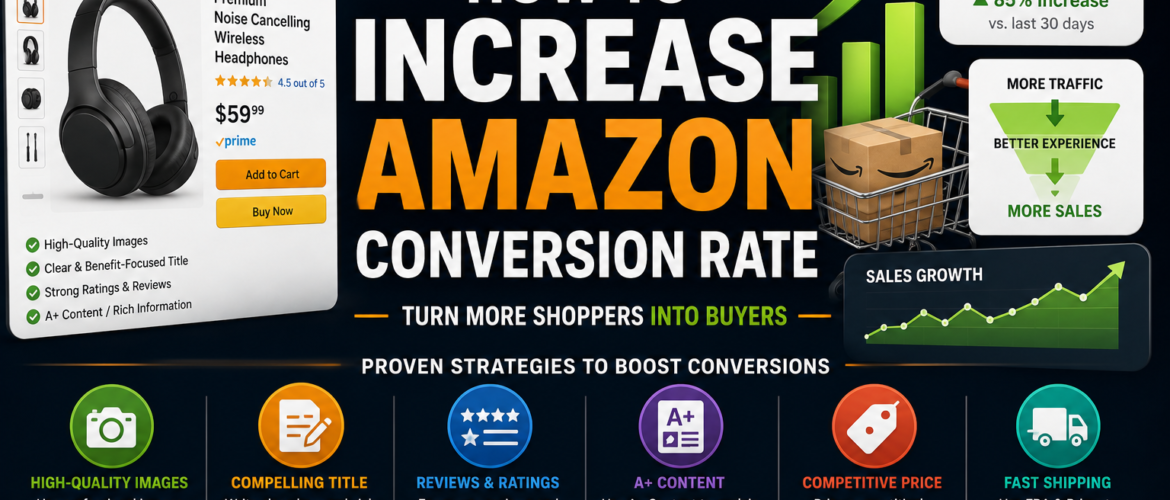
Selling on Amazon has become more competitive than ever. Thousands of new sellers join the marketplace every day, and almost every niche is crowded with competitors offering similar products at similar prices. In this environment, simply getting traffic to your listing is no longer enough. The real success comes from converting that traffic into actual sales.
This is where Amazon conversion rate optimization becomes one of the most important parts of growing an Amazon FBA business.
A higher conversion rate means:
- More sales without increasing traffic
- Lower advertising costs
- Better organic rankings
- Higher profits
- Stronger brand growth
Many sellers spend thousands of dollars on Amazon PPC ads but ignore the actual listing experience. If your product listing is not optimized to convert visitors into buyers, you will continue wasting ad spend and losing sales to competitors.
In this detailed guide, you will learn everything about Amazon conversion rate optimization, including:
- What Amazon conversion rate means
- Why it matters for rankings and profitability
- The average Amazon conversion rate
- Proven strategies to improve conversions
- Common mistakes reducing sales
- Advanced optimization methods used by top Amazon brands
Whether you are a beginner or an experienced Amazon seller, this guide will help you improve your product listings and increase sales.
What Is Amazon Conversion Rate?
Amazon conversion rate refers to the percentage of shoppers who purchase your product after visiting your listing.
It measures how effectively your listing turns visitors into customers.
Amazon Conversion Rate Formula
Conversion Rate=Number of OrdersNumber of Visitors×100\text{Conversion Rate} = \frac{\text{Number of Orders}}{\text{Number of Visitors}} \times 100
For example:
- Your product listing receives 2,000 visitors
- 240 customers purchase the product
Your conversion rate would be 12%.
Why Amazon Conversion Rate Is Important
Many sellers focus only on increasing traffic through PPC ads, external marketing, or SEO. However, traffic alone does not guarantee profitability.
If your listing has poor conversion rates, you may lose money even with high traffic.
Improving your conversion rate can transform your Amazon business because it impacts multiple areas of performance.
1. Better Organic Ranking on Amazon
Amazon’s algorithm is designed to maximize sales. The platform wants to show products that customers are most likely to buy.
When shoppers consistently purchase your product after clicking your listing, Amazon sees your product as highly relevant.
This helps improve:
- Organic keyword rankings
- Search visibility
- Product discoverability
A product with a higher conversion rate often outranks competitors even if those competitors spend more on ads.
2. Lower PPC Advertising Costs
Amazon PPC performance is heavily connected to conversion rates.
If your listing converts poorly:
- Your ad costs increase
- Your ACoS rises
- Your ROI decreases
But when your listing converts well:
- Amazon rewards your ads
- Your CPC becomes more efficient
- Your advertising becomes more profitable
A strong conversion rate allows you to scale ads while maintaining healthy margins.
3. Increased Revenue and Profitability
Improving conversion rate is one of the easiest ways to increase revenue without increasing traffic.
For example:
- Product A converts at 8%
- Product B converts at 16%
If both products receive the same amount of traffic, Product B will generate double the sales.
This means you can make more profit from the same traffic source.
What Is a Good Amazon Conversion Rate?
Conversion rates vary depending on product category, competition, price point, and brand trust.
Here are general Amazon conversion benchmarks:
| Seller Type | Average Conversion Rate |
|---|---|
| New Sellers | 5%–10% |
| Average Listings | 10%–15% |
| Well-Optimized Listings | 15%–25% |
| Top Amazon Brands | 25%–35%+ |
Amazon conversion rates are generally much higher than traditional ecommerce websites because customers already trust Amazon.
Factors That Affect Amazon Conversion Rate
Several factors influence whether a shopper buys your product.
These include:
- Main image quality
- Product reviews
- Star ratings
- Pricing
- Shipping speed
- Product title
- Bullet points
- A+ Content
- Brand trust
- Product videos
- Mobile optimization
- PPC targeting
Optimizing these elements can significantly improve sales performance.
1. Optimize Your Main Product Image
Your main image is the most important visual element on your listing.
Before customers even read your title, they notice your image.
A weak image can destroy conversions instantly.
Why Main Images Matter So Much
Amazon shoppers make decisions very quickly. Most customers compare multiple products within seconds.
Your image needs to:
- Grab attention
- Build trust
- Look premium
- Clearly show the product
If your competitor’s image looks better, shoppers may never click your listing.
Best Practices for Amazon Main Images
Use High Resolution
Blurry images reduce professionalism.
Amazon recommends images that are at least 1600px or larger to enable zoom functionality.
Use Pure White Background
Amazon requires a white background for main images in most categories.
This creates a clean and professional appearance.
Fill Most of the Frame
Your product should occupy around 85% of the image area.
Tiny products in large empty spaces look weak and unprofessional.
Use Proper Lighting
Professional lighting improves perceived product quality.
Avoid:
- Dark shadows
- Poor contrast
- Overexposure
Show Product Clearly
Customers should instantly understand:
- What the product is
- Its shape
- Material quality
- Packaging
Confusing images reduce clicks and conversions.
2. Create High-Converting Product Titles
Your Amazon title has two important jobs:
- Help customers understand the product
- Help Amazon rank your listing for keywords
The challenge is balancing SEO and readability.
Elements of a Great Amazon Title
A good title usually includes:
- Brand name
- Main keyword
- Product type
- Key feature
- Size or quantity
- Important benefit
Example of a Strong Amazon Title
Weak Title
“Women Hijab”
Better Title
“NOOR Premium Chiffon Hijab Set for Women – Lightweight Breathable Non-Slip Scarves – Pack of 5”
This title is more informative, keyword-rich, and professional.
Avoid Keyword Stuffing
Many sellers overload titles with keywords.
Example:
“Water Bottle Stainless Steel Bottle Gym Bottle Leakproof Bottle Insulated Bottle Sports Bottle”
This looks spammy and reduces trust.
Instead, focus on readability and customer experience.
3. Use High-Quality Secondary Images
Secondary images help customers fully understand the product.
They answer questions visually and reduce uncertainty.
Types of Images That Improve Conversion
Lifestyle Images
Show the product being used naturally.
Lifestyle images help customers imagine owning the product.
For example:
- Fitness bottle used in the gym
- Kitchen gadget used while cooking
- Fashion item worn by a model
Lifestyle photography creates emotional connection.
Infographic Images
Infographics communicate key benefits quickly.
They are excellent for showing:
- Dimensions
- Features
- Materials
- Instructions
- Benefits
Good infographics simplify complex information.
Comparison Images
Comparison charts help customers understand why your product is superior.
You can compare:
- Materials
- Durability
- Features
- Package contents
This helps justify pricing and build confidence.
Problem-Solution Images
These images highlight pain points and demonstrate how your product solves them.
This strategy is extremely effective for increasing conversions.
4. Write Benefit-Driven Bullet Points
Many sellers make the mistake of focusing only on features.
Customers care more about outcomes and benefits.
Example
Feature-Focused
“Made with premium cotton”
Benefit-Focused
“Soft breathable cotton fabric keeps you comfortable throughout the entire day”
The second example creates emotional value.
Structure of High-Converting Bullet Points
Each bullet should include:
- Feature
- Benefit
- Emotional outcome
Focus on Customer Pain Points
Think about:
- What problems customers face
- What frustrations they want solved
- What goals they want achieved
Your bullets should directly address these points.
5. Improve Product Descriptions
Your product description provides deeper information about your product.
Although many shoppers scan quickly, descriptions still help:
- Build trust
- Improve SEO
- Reduce hesitation
- Increase conversions
Tips for Better Descriptions
Use Short Paragraphs
Large text blocks are difficult to read.
Break content into smaller sections.
Make It Emotional
Customers buy emotionally before logically.
Use language that creates:
- Excitement
- Confidence
- Comfort
- Security
- Desire
Explain the Experience
Instead of only describing the product, describe how the customer will feel using it.
6. Use Premium A+ Content
A+ Content is one of the most powerful conversion tools available to Brand Registered sellers.
It transforms standard listings into premium branded experiences.
Benefits of A+ Content
Builds Brand Trust
Professional designs make your brand appear more established and reliable.
Increases Engagement
Visual storytelling keeps customers interested longer.
Reduces Customer Confusion
A+ Content explains product details more clearly.
This reduces uncertainty and return rates.
What to Include in A+ Content
- Brand story
- Feature highlights
- Lifestyle banners
- Comparison charts
- Product benefits
- FAQ sections
Premium brands invest heavily in A+ Content because it directly impacts conversions.
7. Increase Product Reviews
Reviews are one of the strongest social proof factors on Amazon.
Customers trust other buyers more than advertising.
Why Reviews Matter
Products with many positive reviews:
- Convert better
- Rank better
- Build trust faster
Shoppers naturally compare review counts before purchasing.
How to Get More Reviews
Deliver Excellent Product Quality
Happy customers leave better reviews.
Improve Packaging
Premium packaging improves customer experience.
Use Amazon Vine
Amazon Vine helps new products gain authentic reviews.
Provide Great Customer Support
Fast support increases customer satisfaction.
Avoid Black-Hat Tactics
Never:
- Buy fake reviews
- Manipulate ratings
- Use review farms
Amazon aggressively suspends sellers for policy violations.
8. Maintain High Star Ratings
Your star rating has a major effect on conversion rates.
A product with:
- 4.8 stars usually converts much better than
- 3.9 stars
Even small rating improvements can significantly impact sales.
Common Causes of Negative Reviews
- Poor quality
- Misleading images
- False claims
- Incorrect sizing
- Weak durability
Fixing these issues improves both reviews and conversions.
9. Optimize Product Pricing
Pricing strongly affects buyer psychology.
Pricing Too High
Customers may choose competitors.
Pricing Too Low
Customers may assume poor quality.
Smart Pricing Strategies
Use:
- Coupons
- Discounts
- Bundles
- Subscribe & Save
- Limited-time deals
These create urgency and improve perceived value.
10. Add Product Videos
Amazon videos are becoming increasingly important.
Videos reduce uncertainty and demonstrate real product usage.
Effective Video Types
Demonstration Videos
Show how the product works.
Lifestyle Videos
Show real-world use cases.
Problem-Solution Videos
Demonstrate how your product solves customer frustrations.
Unboxing Videos
Improve perceived quality and trust.
11. Improve Shipping Speed
Fast delivery improves customer confidence.
Prime shipping significantly increases conversion rates.
Why Fast Shipping Matters
Customers want convenience and reliability.
Long delivery times reduce purchase intent.
Best Practices
- Use Amazon FBA
- Maintain inventory
- Avoid stock-outs
- Forecast demand properly
12. Optimize for Mobile Devices
A huge percentage of Amazon shoppers use mobile phones.
Your listing must look clean and easy to understand on smaller screens.
Mobile Optimization Tips
Keep Titles Readable
Avoid excessively long titles.
Use Clear Images
Text inside infographics should remain readable on mobile.
Put Important Information Early
Customers may not scroll far.
13. Improve PPC Traffic Quality
Sometimes poor conversion rates are caused by irrelevant traffic.
If your ads target the wrong audience, visitors will not purchase.
PPC Optimization Tips
Remove Poor Keywords
Pause keywords with:
- High spend
- Low conversions
Focus on Buyer Intent
Target keywords that indicate purchasing behavior.
Example:
- “best insulated water bottle”
- “premium yoga mat”
These convert better than broad informational keywords.
14. Reduce Product Returns
High return rates hurt long-term performance.
Amazon notices products with excessive returns.
Common Reasons for Returns
- Product mismatch
- Poor quality
- Inaccurate descriptions
- Wrong size
- Unrealistic expectations
How to Reduce Returns
Use Accurate Images
Show realistic product colors and dimensions.
Provide Clear Instructions
Especially for technical products.
Set Proper Expectations
Never exaggerate claims.
15. Build a Strong Brand
Brand trust is becoming increasingly important on Amazon.
Customers feel more comfortable buying from recognizable brands.
Ways to Build Brand Authority
- Consistent packaging
- Premium listing design
- Professional storefront
- Strong social media presence
- High-quality A+ Content
Branding increases long-term conversion performance.
Advanced Amazon Conversion Optimization Strategies
A/B Test Your Listing
Testing is essential.
Even small improvements can increase revenue significantly.
Test These Elements
- Main image
- Product title
- A+ Content
- Price
- Videos
- Bullet points
Use Amazon’s “Manage Your Experiments” tool whenever possible.
Study Competitor Listings
Top competitors provide valuable insights.
Analyze:
- Their image style
- Keywords
- Review complaints
- Positioning
- Branding
Then improve on their weaknesses.
Monitor Business Reports
Track metrics such as:
- Unit Session Percentage
- Sessions
- Order percentage
- PPC conversion rate
- Return rate
Data-driven optimization leads to better decisions.
Common Amazon Conversion Rate Mistakes
Poor Listing Images
Weak visuals reduce trust instantly.
Keyword Stuffing
Unreadable listings hurt conversions.
Weak Branding
Generic listings struggle to compete.
Low Review Count
Customers hesitate to buy unproven products.
Poor Product Quality
No listing optimization can fix a bad product.
Ignoring Customer Feedback
Reviews reveal exactly what customers want improved.
Final Thoughts
Increasing Amazon conversion rate is one of the most powerful ways to grow an Amazon FBA business.
Instead of focusing only on traffic generation, successful sellers optimize every part of the customer journey.